Inverses
Every function has an inverse that is symmetrical about the y=x line. In order to find an inverse of a function you switch the input for the output and solve. For example f(x)=x^2. When you switch the input for the output you get x=f(x)^2 and solve for f(x) but now f(x) changes to f-1(x) indicating it's the inverse of f(x).
Logarithms
Logs which are the inverses of exponential function are written as log b("x")="y". The equation can also be written in exponential form which would be x=b^y. Writing it in exponential form shows that when you have the equation in log form you have the log equal to the power. Because the b became the base, "y" the power, and "x" what it all equals to as seen in the following image.
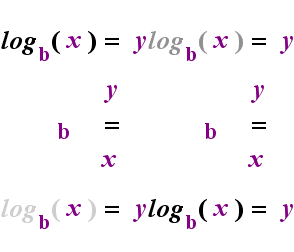
When a log is denoted with no base the default base is 10 and when a log is shown as ln it is the same as log with a base of e. Also when the base of a log is the same as the "x" it cancels out as well as when it's a number to the log base of that same number. For example log2^2^x=3 the log 2 and 2 would cancel out. They would also cancel if it was something like 2^log2x=3.
What I Don't Understand
I don't understand problems like #35 on pg 44 which was e^x + e^-x=3


Your blog taught me how to graph logs:]
ReplyDeleteI'm sorry i can't help you with # 35, lol