Types Problems I Did Not Understand
1) #9 from pg 95 lim (xcscx+1)/(xcscx) and other problems like this involving the dividing of trig functions
x->0
2) #5 on pg 95
3) # 14 on pg 92 f(x)= |x-2| at x=1
Tuesday, December 8, 2009

Tuesday, November 24, 2009
Colleges
1) Majors
-Animal Behavior and Etholgy: This is the study of how and why animals behave the way they do.
-Zoology: The study of animals, what they're made of, and thier activities.
-Wildlife Biology: The biological study of animals with backbones, their habitats and ecosystems
-Animal Training: The study of animal psychology, human-animal interaction, the learning and behavioral characteristics of different animals, and different training methods to be able to train animals.
-Animal Nutrition: The study of how to make animals healthier through good nutrition
2) Colleges
-University of California Davis: You can earn a degree ranging from bachelor's to a doctorate. The majority of stusents accepted are from in state.
-Colorado State University: Degree's earned range from bachelor's to first professional and 86% of applicants are admittedwith 20% being out of state.
-Becker College: This school is located in Worcester, Massachussetts and you can earn a bachelor's degree and an associate's degree. 72% of applicants are accepted with 34% being out of state.
-Animal Behavior and Etholgy: This is the study of how and why animals behave the way they do.
-Zoology: The study of animals, what they're made of, and thier activities.
-Wildlife Biology: The biological study of animals with backbones, their habitats and ecosystems
-Animal Training: The study of animal psychology, human-animal interaction, the learning and behavioral characteristics of different animals, and different training methods to be able to train animals.
-Animal Nutrition: The study of how to make animals healthier through good nutrition
2) Colleges
-University of California Davis: You can earn a degree ranging from bachelor's to a doctorate. The majority of stusents accepted are from in state.
-Colorado State University: Degree's earned range from bachelor's to first professional and 86% of applicants are admittedwith 20% being out of state.
-Becker College: This school is located in Worcester, Massachussetts and you can earn a bachelor's degree and an associate's degree. 72% of applicants are accepted with 34% being out of state.
Monday, November 23, 2009
Tips and Hints
1) Remembering Transformation
All you have to remember is that when the x (input) is being changed then the graph is moving along the x- axis by the opposite of what you're doing to it. So if you add to the x you shift the graph to the left and vice versa when you subtract. Also when you multiply the x instead of stretching out the graph you compact it and vice versa when you divide. When the change is occuring top the x its always going to have parentheses around the x and the change that'a occuring to it. When the change is occuring to the output (y or f(x)) then you do exactly what the change says along the y-axis. So if you're adding to the output then the graph shifts up and vice versa when you subtract. And when you multiply the output then you stretch out the graph. For example if you double the output then the parent function y-coordinate points are all doubled and vice versa when you divide.
2 and 3) Trigonometry
I don't really know how i remember all the trigonometry stuff, i just do. So I don't know any tips or hints i can tell to help anybody else who needs them. Nothing worries me or still confuses me off the top of my head. I pretty much understand everything that we've been doing and learning about trigonometry.
All you have to remember is that when the x (input) is being changed then the graph is moving along the x- axis by the opposite of what you're doing to it. So if you add to the x you shift the graph to the left and vice versa when you subtract. Also when you multiply the x instead of stretching out the graph you compact it and vice versa when you divide. When the change is occuring top the x its always going to have parentheses around the x and the change that'a occuring to it. When the change is occuring to the output (y or f(x)) then you do exactly what the change says along the y-axis. So if you're adding to the output then the graph shifts up and vice versa when you subtract. And when you multiply the output then you stretch out the graph. For example if you double the output then the parent function y-coordinate points are all doubled and vice versa when you divide.
2 and 3) Trigonometry
I don't really know how i remember all the trigonometry stuff, i just do. So I don't know any tips or hints i can tell to help anybody else who needs them. Nothing worries me or still confuses me off the top of my head. I pretty much understand everything that we've been doing and learning about trigonometry.
Saturday, November 14, 2009
Logs and Inverses
What I Understand
Inverses
Every function has an inverse that is symmetrical about the y=x line. In order to find an inverse of a function you switch the input for the output and solve. For example f(x)=x^2. When you switch the input for the output you get x=f(x)^2 and solve for f(x) but now f(x) changes to f-1(x) indicating it's the inverse of f(x).
Logarithms
Logs which are the inverses of exponential function are written as log b("x")="y". The equation can also be written in exponential form which would be x=b^y. Writing it in exponential form shows that when you have the equation in log form you have the log equal to the power. Because the b became the base, "y" the power, and "x" what it all equals to as seen in the following image.
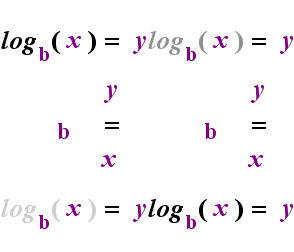
When a log is denoted with no base the default base is 10 and when a log is shown as ln it is the same as log with a base of e. Also when the base of a log is the same as the "x" it cancels out as well as when it's a number to the log base of that same number. For example log2^2^x=3 the log 2 and 2 would cancel out. They would also cancel if it was something like 2^log2x=3.
What I Don't Understand
I don't understand problems like #35 on pg 44 which was e^x + e^-x=3

Inverses
Every function has an inverse that is symmetrical about the y=x line. In order to find an inverse of a function you switch the input for the output and solve. For example f(x)=x^2. When you switch the input for the output you get x=f(x)^2 and solve for f(x) but now f(x) changes to f-1(x) indicating it's the inverse of f(x).
Logarithms
Logs which are the inverses of exponential function are written as log b("x")="y". The equation can also be written in exponential form which would be x=b^y. Writing it in exponential form shows that when you have the equation in log form you have the log equal to the power. Because the b became the base, "y" the power, and "x" what it all equals to as seen in the following image.
When a log is denoted with no base the default base is 10 and when a log is shown as ln it is the same as log with a base of e. Also when the base of a log is the same as the "x" it cancels out as well as when it's a number to the log base of that same number. For example log2^2^x=3 the log 2 and 2 would cancel out. They would also cancel if it was something like 2^log2x=3.
What I Don't Understand
I don't understand problems like #35 on pg 44 which was e^x + e^-x=3
Saturday, November 7, 2009
Even and Odd Functions
A function is an even function if f(x)=f(-x) because any input and its opposite in f(x) or f(-x) would yield the same output which would turn out in a mirror image along the y-axis. For example f(x)=x^2=f(-x)=(-x)^2. For f(x) when the input is 2 the output is 4, when the input is -2 the output is 4. And in the function is f(-x)=x^2 the output ends up being the the same as f(x). Like when you input 2 the output is 4, and if you input -2 the output is 4. So when you graph either function it is symmetrical along the y-axis.

A function is an odd function if f(-x)=-f(x) because now the input and its opposite yield opposite outputs. For example f(x)=x^3. Now f(x) does not equal f(-x) but f(-x)=-f(x). Because of this the graph is no longer symmetrical along the y-axis but it's symmetrical about the origin or symmetrical 2 twice over.


A function is an odd function if f(-x)=-f(x) because now the input and its opposite yield opposite outputs. For example f(x)=x^3. Now f(x) does not equal f(-x) but f(-x)=-f(x). Because of this the graph is no longer symmetrical along the y-axis but it's symmetrical about the origin or symmetrical 2 twice over.

Tuesday, October 27, 2009
About Me
Alright so my name is Alejandro but everyone calls me Alex. I'm 17 years old and I'm a senior. My favorite things in life are eating, sports, working out (though I haven't worked out in a while),sleeping, eating, video games, and did I mention eating. Most of the people I hang out with call me obese because I'm always hungry and when I'm eating I eat a lot. I'm a pretty chill guy and I'm always cracking jokes.
Subscribe to:
Posts (Atom)
